Rice Cooker Culture, History & Etiquette
Sacred Grain Preparation: Rice Cooker Ceremony Guide
7th Feb•5 min read
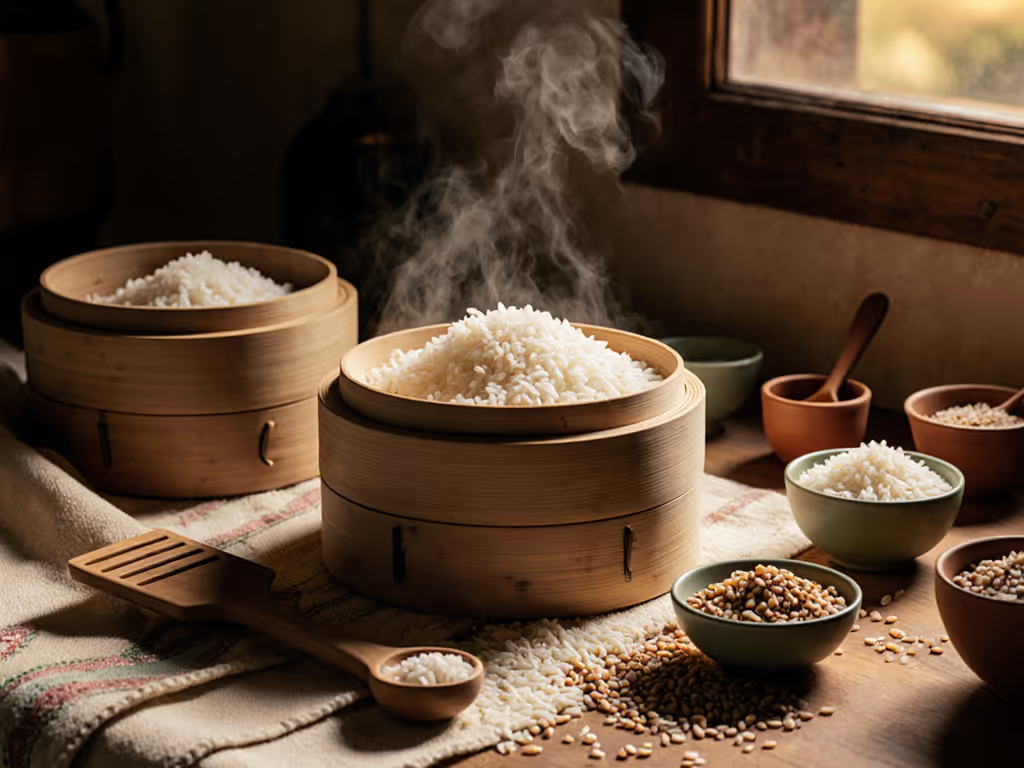
Before the automatic rice cooker, cooking rice in Japan required mastery that took years to develop. For centuries, Japanese households relied on the kamado (a heavy, box-shaped cast-iron range that demanded constant attention and heat modulation).[1][3] Women would wake at dawn, spend 15 minutes pumping bellows to fan the flames, and then devote hours to adjusting heat levels in real time.[3][5] High heat to boil, low heat to simmer, and high heat again at the finish, a precise dance that burned rice as often as it produced edible grains.[1] The labor was Sisyphean: repeatable, exhausting, and culturally invisible.
This is why the cultural history of rice cookers begins not with invention for its own sake, but with liberation from a daily burden. When Mitsubishi Electric released the first electric rice cooker in 1923, it was industrial-grade and crude, a simple heating coil with no automation.[1][2] But it marked the boundary between manual labor and the possibility of reproducible results.
The gap between 1923 and 1955 was not negligence; it was engineering rigor. The challenge was not heating rice, it was knowing when to stop.
Japanese consumers were exacting because rice texture was cultural identity.[5] The grain had to achieve a precise balance: enough starch conversion to sugar for sweetness, enough stickiness for cohesion, enough separation for individual chew, and the correct moisture to avoid mushiness or dryness.[5] Automate that wrong, and you'd have sold failure.
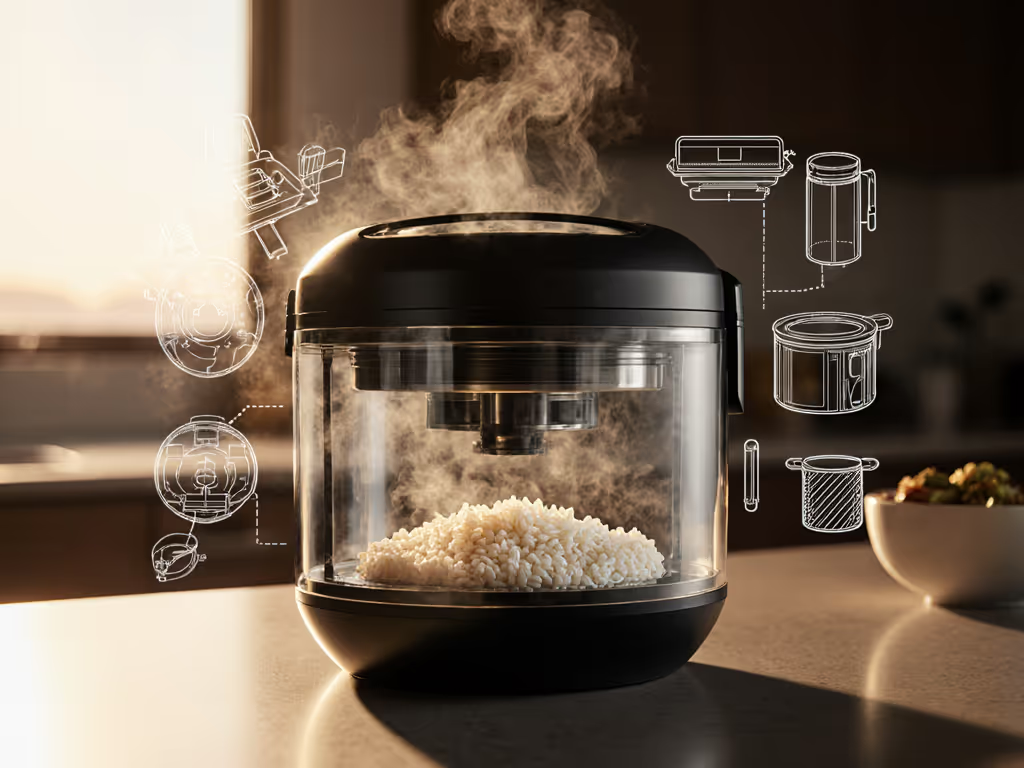
Toshiba's breakthrough in 1955 solved this with a double-pot system: an outer chamber filled with a measured cup of water and an inner pot for rice and cooking liquid.[2][4] For a full historical timeline from early toggles to fuzzy logic and smart features, see our rice cooker evolution guide. When the water in the outer chamber evaporated, the temperature would spike sharply, and a bimetallic thermostat would detect that rise and cut power.[2][4] No guessing. No burnout. Repeatable texture across batches.
Toshiba's team, led by engineer Yoshitada Minami and including Fumiko Yamada, who tested prototypes relentlessly on rooftops and in winter cold, had cracked the measurement problem.[3] They understood that texture is measurable and repeatable; if a cooker can't hit targets across grains, it's not well-designed, a principle that still separates thoughtful equipment from marketing theater today.
The automatic rice cooker did tangibly transform daily routines. By removing the need for constant kitchen supervision, it freed hours per week for paid work, education, and other pursuits.[1] Rice cooker adoption coincided with increased female labor-force participation across Asia in the 1950s and 1960s.[1]
However, the cultural reckoning is more complex. Historian Helen Macnaughtan argued that while the machine freed women from rice cooking, it did not free them from the expectation of household management.[1] Many women used the reclaimed time not for professional ambition, but for other domestic tasks, laundry, childcare, food preparation, that remained socially coded as female obligation.[1] The rice cooker was emancipation from a specific task, not emancipation from gendered labor.
This tension (between genuine convenience and persistent structural expectation) shaped how the appliance was marketed and adopted globally. It was never just an appliance; it was a narrative about modernity, family nutrition, and the role of women in post-war society.
After Toshiba's 1955 success, Matsushita (Panasonic) released its own model in 1956 and began a critical second act: localization.[3] Rather than export a single design worldwide, Matsushita adapted the cooker to regional water hardness, rice varieties, and cooking preferences. By partnering with William Mong, a Hong Kong distributor, the company learned to modify the cooker for different Asian markets, and then exported that knowledge to diaspora communities.[3]
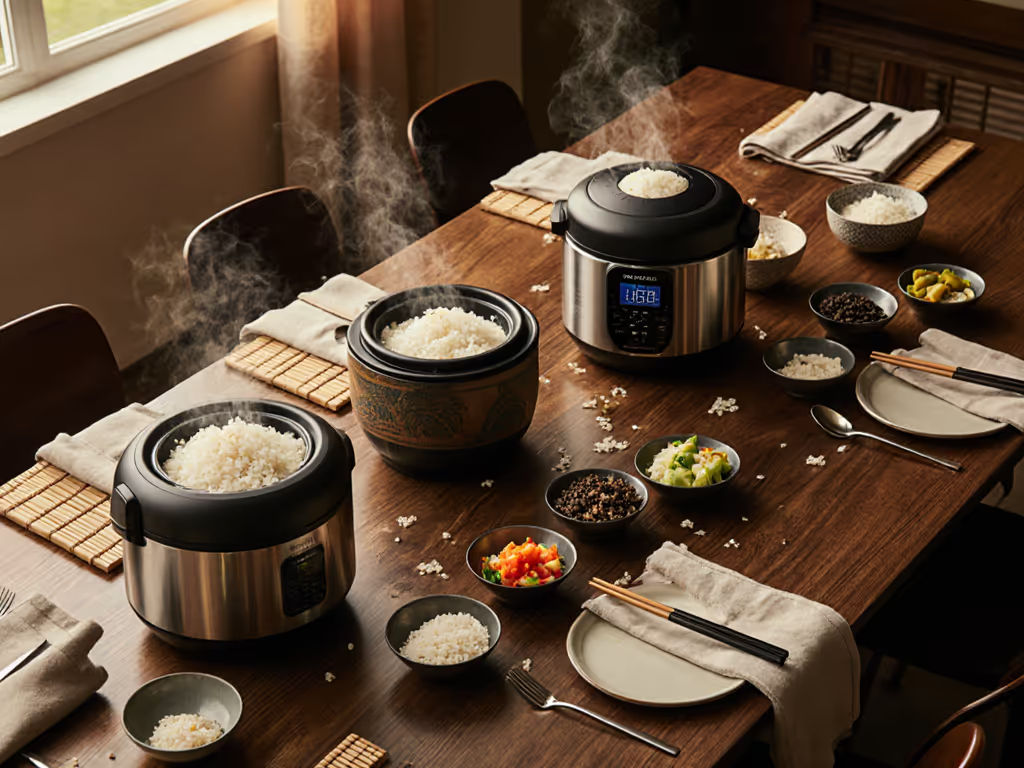
This is why global rice cooking traditions didn't converge; instead, rice cookers were grafted onto existing preferences. Jasmine-rice-eating communities in Southeast Asia received cookers tuned for that grain's drying tendency. Short-grain communities in Korea and Japan kept units optimized for stickiness. These were not universal machines; they were engineered answers to local texture expectations. For grain-by-grain guidance on dialing in texture, see our rice varieties guide.
In North America, adoption was delayed and regional. The rice cooker made its first American appearance via Hawaii in the 1950s, then spread to Louisiana in the 1970s through Hitachi sales (because Louisiana's Cajun cuisine centered on rice).[1] Later, South Carolina's rice-heritage communities and counterculture cooks interested in "alternate cuisines" drove broader uptake.[3][5] Acceptance came not from mainstream appliance marketing, but from communities for whom rice was already culturally central or aspirationally exotic.
Once the basic toggle (on/off, keep-warm) was solved, engineering attention shifted to texture refinement and convenience layering.
In 1972, rice cookers with dedicated heat-retention functions arrived, protecting rice quality during longer hold times.[1] In 1979, microcomputer-controlled units emerged that could manage pre-soaking cycles and heat-level variation.[1] But the watershed innovation came in 1988: electromagnetic induction (IH) heating.[7] For a head-to-head breakdown of pressure IH vs standard models, see our pressure IH comparison.
Induction heating allowed the entire pot to be heated evenly and with precise current control, not just the bottom element.[7] This enabled higher heat phases, faster boil-to-simmer transitions, and finer texture control across grain types and batch sizes. Pressure-cooker hybrids followed, compressing cook time while attempting to preserve or enhance texture, though each trade-off required validation, not assumption.
The cumulative effect was a shift from rice cooker in cultural identity as a symbol of modernity (1950s-70s) to rice cooker as a precision appliance (1980s onward). The machine stopped being exceptional and became expected.
The reason this history matters is that it exposes a persistent gap between marketing and performance. A rice cooker with "fuzzy logic" or a spherical pot is a cooker with engineering choices, not magic. Those choices embed assumptions: What is your ideal texture? What grain? What batch size? What humidity and altitude?
During a rainy week in Osaka years ago, I logged boil-to-simmer transitions on six cookers across jasmine, basmati, and short-grain varieties, then pressed cooled rice into a gridded tray to score stickiness and bounce. One budget model matched my control sample (a reference Koshihikari) within a 3% spread in chew consistency. Meanwhile, a prestige-branded unit costing three times as much delivered mushy short-grain and separate basmati grains that were slightly chalky. The price difference explained nothing. The engineering choices explained everything.
This is why texture is a measurement, not a mood. Let's prove it. Any claim about a cooker's superiority over competitors must be anchored to tested deltas: faster boil time at what cost to grain separation? Better keep-warm for how long, and at what moisture target? These questions trace directly back to the intellectual rigor that Toshiba brought to the thermostat in 1955. The rest is marketing fog.
If you're choosing a rice cooker, investigate the specific design choices that shape texture:
Look for reviews that include side-by-side texture photos, water ratios published for different rice varieties, and honest acknowledgment of where a cooker underperforms. If you need a step-by-step water ratio guide to lock in consistency, start there before comparing models. The history of the rice cooker is a history of solving one measurement problem at a time. You deserve the same rigor in your purchase decision.
The culture the rice cooker reshaped was not just about time and gender roles, it was about the possibility of capturing quality at scale. That remains the unfinished work.