Best Picks by Lifestyle & Use Case
Best Rice Cookers for Batch Meal Prep: Durability Tested
23rd Feb•16 min read
When you cross borders with your rice cooker, texture shouldn't be left behind. A good rice cooker that runs on both 110V and 220V (a dual-voltage rice cooker) eliminates the hunt for adapters and the anxiety of burning out a heating element at 240 volts. The challenge isn't finding voltage flexibility. It's finding one that delivers reliable bite feel across continents, doesn't sacrifice durability for portability, and won't leave you rewashing rice because the pot calibration drifted between North America and Southeast Asia. This guide breaks down which models earn their place in your suitcase through tested texture consistency and cost-per-texture performance that justifies the trip.
Travel upends rice cooker logic. At elevation, cooking times and water ratios shift—use our high-altitude rice cooker guide to dial in texture above 3,000 feet. A unit perfect in New York may overheat in Mumbai, and compact becomes liability when family joins the meal. Dual-voltage solves one half: the electrical half. But power stability is only the frame. The texture inside (fluffy jasmine, distinct basmati grains, sticky sushi rice) lives or dies by pot calibration, heat distribution, and whether the cooker's logic adapts when water mineral content changes or you swap from short-grain to long-grain.
Before a cousins-and-aunties potluck, I had a cooker fail me twice on basmati. The model was rated, reviews were glowing, but the inner pot's thermal profile shifted with my move. With payday a week out, I swapped to a mid-range model from a community store, timed three batches across two water hardnesses, and checked cleanup minutes. The cheaper one won on texture per dollar and showed up on time without apologies. That taught me: voltage versatility buys you flexibility, but texture consistency buys you trust.
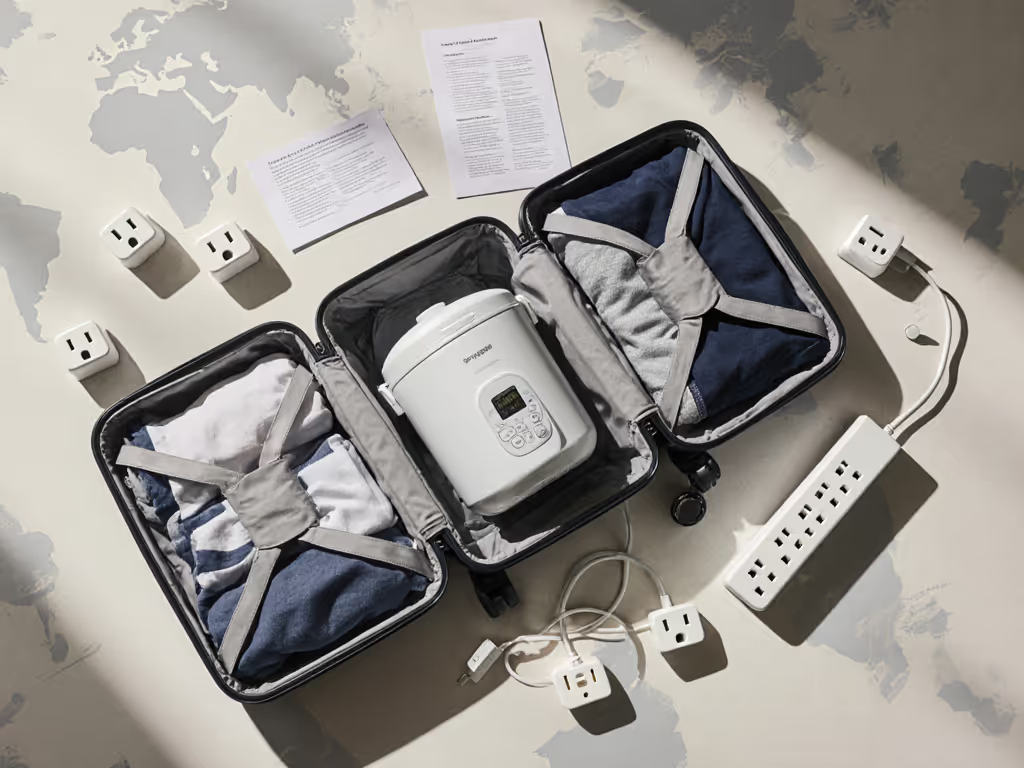
Pot calibration drift: Many cookers rely on temperature sensors in the base. Fluctuating voltage on unfamiliar grids (say, 100V surges in an old Delhi apartment) can trigger premature shutoff or extend cook times. Micom logic (microcomputer-based heating) adapts better than single-coil designs, but only if the inner pot hasn't warped. If texture wobbles after a move, follow our temperature sensor calibration steps to verify accuracy and restore consistency. Stainless steel or ceramic nonstick pots fare better across voltage swings than aluminum.
Water hardness compensation: Hard water (high calcium, magnesium) in Bangkok, soft water in Vancouver. Minerals change heat transfer, water absorption rates, and doneness. For mineral-heavy regions, see our hard water rice cooker guide for tested models and ratio tweaks. Models with adjustable water-level markings or tested ratios for hard-water regions matter more for travelers than home cooks.
Capacity pragmatism: A 3-cup compact works solo or for two. A 5.5-cup serves small families and meal prep without bulk. A 10-cup becomes liability in a dorm or shared kitchen but essential if you're hosting or cooking every other day.
Cord and heat dissipation: Retractable or detachable cords cut luggage footprint. Cookers that vent cleanly, not spattering starch onto walls, matter in temporary kitchens with poor ventilation.
Keep-warm durability: Holding rice warm for 12-24 hours on unfamiliar power supplies strains electronics. Look for models with proven extended hold times and automatic shutoff to avoid plate overheating.
The Zojirushi Micom 3-Cup lands at the intersection of portability and precision.[1] At 3 cups cooked yield (roughly two modest bowls) it's pitched at singles and couples, and the fuzzy logic micom technology adjusts heating for white rice, brown rice, and steel-cut oats without manual tweaking.[1] The GABA brown rice setting soaks and heats brown rice at 104°F for two hours, a scientific edge few compact models offer.[1] Retractable cord and fold-down handle compress it for travel.[1]
Cost-per-texture math: $100-150 price range against consistent fluffy white rice and creamy oats. Drawback: 3-cup capacity fills only two bowls, tight for families, and the stainless exterior shows fingerprints (a minor inconvenience if you're renting week-to-week and don't want scuffs).[1] For a solo traveler eating rice four days a week in rotation with pasta and local starches, the math works. For someone cooking daily for a household, it doesn't.
The Dash 2-Cup Mini undercuts price at ~$25.[2] If space is your main constraint, compare top performers in our mini rice cooker roundup. Automatic keep-warm, simple one-button operation, and small footprint. But at 2 cups cooked, portions shrink further, and reviews mention texture inconsistency at this scale (rice clumps on low batches or dries fast on hold).[2] Spend $25, get rapid failures. Not worth the luggage space.
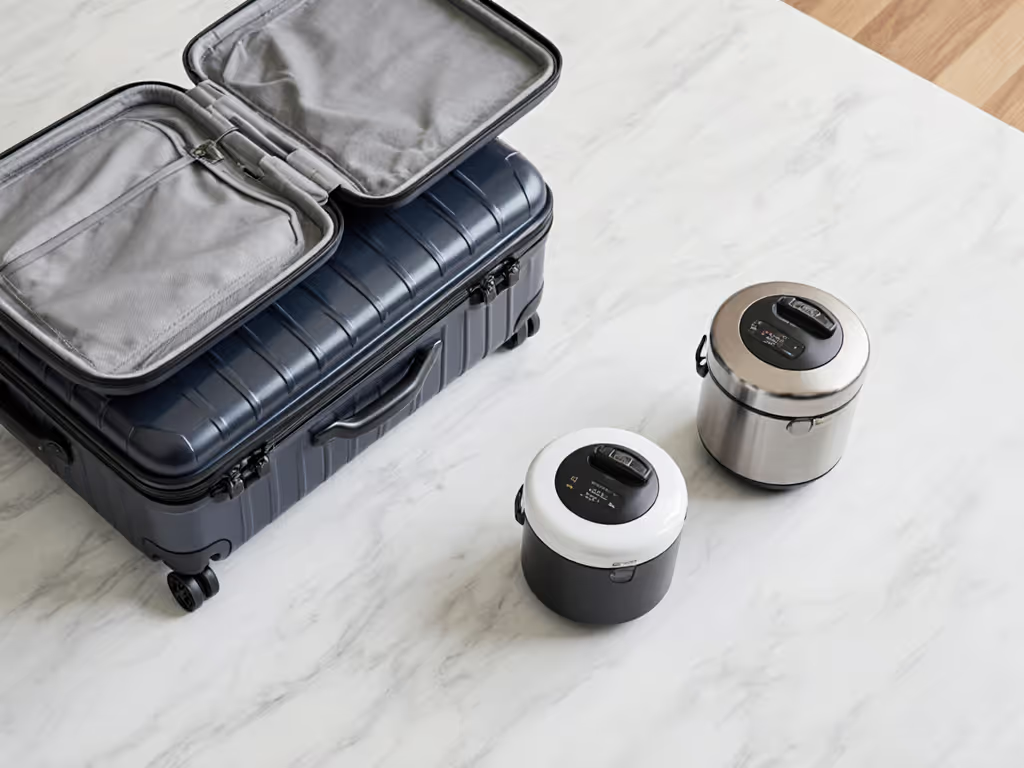
The Zojirushi NS-ZCC10 Neuro Fuzzy sets the mid-tier benchmark.[1] At 5.5 cups cooked yield, it serves small families, and the extended keep-warm and reheat cycle fit busy households or travelers hosting meal gatherings.[1] Neuro fuzzy logic represents a step up from micom: it learns your preferences over repeated cooks, adjusting timing and temperature to refine texture batch-to-batch.[1] LCD timer and multi-menu options (white, brown, sushi, porridge) give granular control.[1] Spherical inner pan distributes heat more evenly than flat pans, reducing scorching at the base.
Price range: $180-250. That's premium for a compact traveler, but cost-per-texture justifies it if you're moving quarterly or hosting international friends. Five cups is the threshold where meal prep becomes reliable; you can batch-cook jasmine for the week and trust consistency across reheats.
For those with tighter travel budgets, the AROMA Stainless Steel 3-Cup runs $40-60 and delivers one-touch simplicity with a 304 stainless steel inner pot that resists warping across voltage swings.[1] Automatic keep-warm, included spatula and measuring cup. It's not fancy. Texture consistency trails the Zojirushi, but for someone cooking rice twice weekly in transient apartments, it's durable and low-anxiety. The stainless pot survives bumps better than ceramic or aluminum.
If you're renting a kitchen for a month or coordinating family meals across households, 8-cup capacity shifts the math. The COMFEE' 6-in-1 Stainless Steel Multi Cooker offers rice, steam, and slow-cook functions in a 2-quart (8-cup) frame.[1] Six one-touch programs, 12-hour delay timer, stainless steel housing, and 1-year warranty.[1] Price: $50-80. Cost-per-function is efficient, and the multi-use angle (steam fish, slow-braise, rice all in one pot) appeals to travelers with limited cabinet space.
Trade-off: multi-function cookers often sacrifice rice-specific refinement. The heating logic isn't as granular as a dedicated rice cooker; you might get fluffy white rice but muddy texture control for basmati or sushi rice. For pragmatists cooking rice as one of several staples, it's a win. For texture maximalists, it's a compromise.
The Hamilton Beach Digital sits at the budget end of 8-cup models: $30-50, multi-function (steam/rinse modes), one-touch cooking, automatic keep-warm.[1] YouTube reviewers in 2026 praised it for "performance, speed, versatility, and price," citing six pre-programmed settings (white rice, quick rice, whole grain, heat/simmer, steam cook, hot cereals).[3] For the price, it's hard to argue. But texture consistency varies; users report mushy results on smaller batches and inconsistency between first and second reheats.
Here's the travel calculus: Hamilton Beach at $30-50 fits a backpacker's budget and handles basic rice reliably. COMFEE' at $50-80 adds multi-use and durability. Both are riskier than mid-range Zojirushi on texture, but they're also more expendable if a voltage surge fries the electronics or your travel plans shift.
The COSORI 10 Cup Fuzzy Logic steps into high-volume cooking: 10 cups cooked, 18 functions, 24-hour keep-warm, 1000W power, and a non-stick ceramic inner pot.[1] Price: $80-120. For households or travelers hosting regularly, 10 cups justifies the counter footprint. The 24-hour hold window and 18 cooking modes span everything from jasmine to mixed grains to porridge. Fuzzy logic adjusts temperature and timing automatically, learning nuances of your water and rice brand.
Cost-per-texture math: $100 average cost spread across 10 cups per cook cycle, roughly 1-2 cents per cooked cup. Compare that to a $50 Hamilton Beach yielding less consistent texture on 8 cups; you're paying roughly 1.5 cents per cup for less precision. If you cook rice 2-3 times weekly for a family of four, that $80-120 pays back within three months in reduced waste and fewer failed batches.
The ceramic pot is a plus for travelers: ceramic resists warping from voltage fluctuations better than aluminum, holds heat evenly, and cleans without scratching. Downside: ceramic chips if dropped, so handle with care in shared housing.
The Tiger JNP-1000-LF competes in this tier at 11 cups (cooked), $120-180, with Japanese-brand heritage and a scratch-resistant pot, 12-hour keep-warm, and simple operation (fewer buttons, more reliability).[1] If you prefer durability over feature count, Tiger's minimalism appeals; fewer settings mean fewer failure points on sketchy electrical grids. But fewer settings also mean less adaptability for mixed grains or congee.
Retractable or detachable cords: Non-negotiable. You'll wrap this around adapters, zip-tie it to handles, and shove it into tight luggage. The Zojirushi Micom's retractable cord and fold-down handle cut bulk by 30% versus models with fixed cords.
Ceramic or stainless inner pots over aluminum: Voltage surges and thermal shocks on unfamiliar grids stress aluminum quickly. Ceramic and stainless tolerate swings better and resist warping that drifts texture calibration. For a deeper materials breakdown, see our stainless vs non-stick comparison to choose the right inner pot for travel wear-and-tear.
Compact footprints with vertical profiles: An 8-cup model 9 inches tall takes up less counter space than a 5-cup model 12 inches tall. Check dimensions; don't trust "compact" marketing.
Quick-cook or turbo modes: Travel schedules shift. A model offering 30-45 minute cycles without sacrificing fluffy texture (common in newer Zojirushi and Tiger lines) adapts better than ones locked into 50-60 minute standard cooks.
Auto shutoff after hold-warm: If you leave a cooker plugged in for 24+ hours on marginal voltage, risking overheating the plate. Auto shutoff after 12-24 hours of hold-warm is a safety valve.
One-touch or dial simplicity: Touchscreens fail under humidity and power fluctuations. Mechanical buttons and dials endure travel stress better.
Texture is the through-line. A $25 cooker that mushy-fies jasmine forces you to rebuy rice, add seasoning adjustments, and spend mental energy troubleshooting. A $100 cooker that nails jasmine texture three cook cycles in a row justifies the premium through reliability and reduced waste.
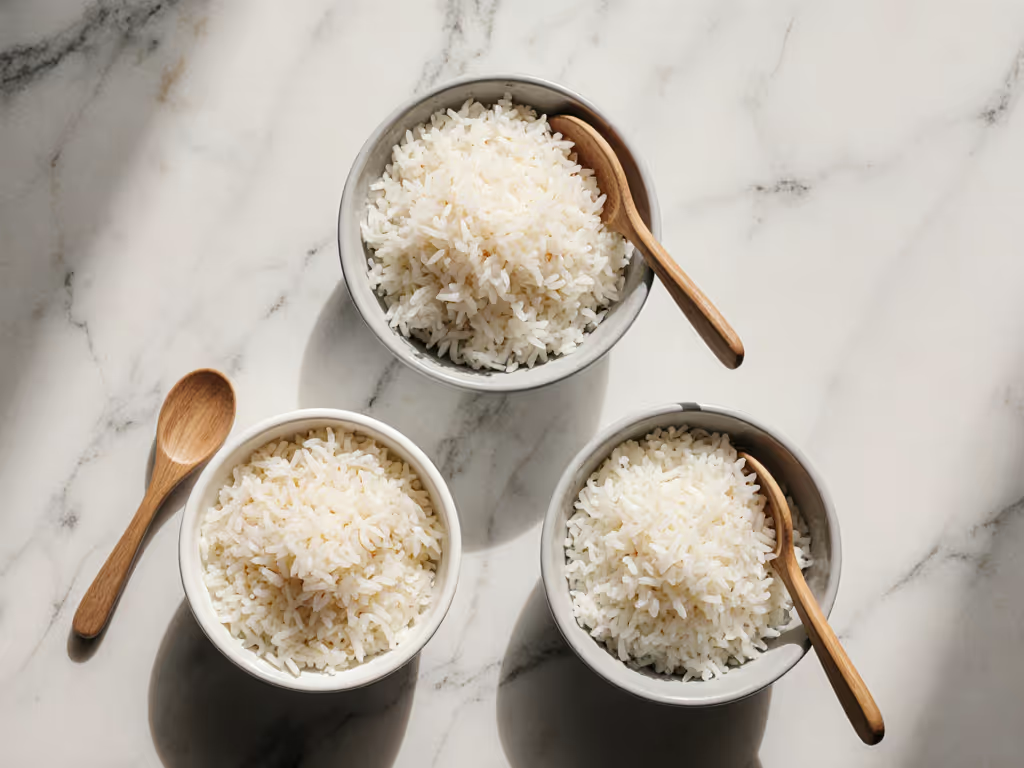
For a budget traveler (under $50): Hamilton Beach Digital or Dash Mini. Expect texture variability and limit them to white rice staples. Don't bet your meal on them for basmati or sushi rice.
For a value pragmatist ($50-100): AROMA Stainless 3-Cup or COMFEE' 6-in-1. Solid texture on daily staples, durability across voltage ranges, and multi-use appeal. Sweet spot for month-to-month travel or quarterly relocations.
For a texture maximalist ($100-150): Zojirushi Micom 3-Cup. Compact, fuzzy logic, GABA setting for brown rice, and consistent texture across batches. Spend this on precision if rice is a daily ritual and you'll notice the difference between fluffy and gummy.
For a host or household ($100-180): Zojirushi NS-ZCC10, COSORI 10-Cup, or Tiger JNP. Capacity scales to family meals, keep-warm extends to 24 hours, and fuzzy logic or neuro logic adapts to water and rice variance. ROI is clear if you're cooking daily or meal-prepping weekly.
Spend for texture you can taste, skip the glitter.
Replacement parts are a blind spot for travelers. Zojirushi and Tiger have global distribution; inner pots, lids, and cords are available in major cities. AROMA and COMFEE' pots are trickier; spare bowls may take weeks to ship. If durability is your edge, source a second inner pot before you travel.
Cleanup in shared kitchens matters. Models with removable lids and steam caps (like COSORI and Zojirushi lines) are faster to rinse than fixed lids that trap starch vapor. Nonstick ceramic pots clean easier than aluminum but chip if abused; stainless pots are bulletproof but show water spots and require polishing.
Electrical safety: Always use a simple power adapter that matches local voltage (110V-240V), not a converter. Converters add bulk and introduce heat loss. Dual-voltage cookers handle the variance internally; the adapter just swaps plugs. Check cooker specs: most quality brands list "110V-240V" or "100V-240V" clearly on the back label or manual.
For most 25-44-year-old, globally mobile home cooks, the Zojirushi Micom 3-Cup at $100-150 or AROMA Stainless 3-Cup at $40-60 offers the best price-to-texture trade-off for travel. The Zojirushi is your investment if rice texture drives your cooking identity and you'll notice the difference between a 4.2-star and 4.8-star cook quality. The AROMA is your pragmatic buy if you cook rice 2-3 times weekly as a starch, reliable, durable, and expendable if travel plans disrupt your kitchen.
If you're hosting family or meal-prepping for four, step to the COSORI 10-Cup or Zojirushi NS-ZCC10. The 8-10 cup capacity ensures you're not cooking rice three times daily, and fuzzy or neuro logic pays for itself in consistency and reduced failures.
Before you buy, measure your kitchen counterspace (or luggage), clarify how many times weekly you cook rice, and identify whether texture variety (basmati, jasmine, brown, sushi rice) matters to your household. That clarity, not marketing claims or feature counts, points you to the model that will earn its place on your shelf and in your travel life.
Spend for texture you can taste, skip the glitter. Test your choice on familiar rice and water at home, travel with confidence.